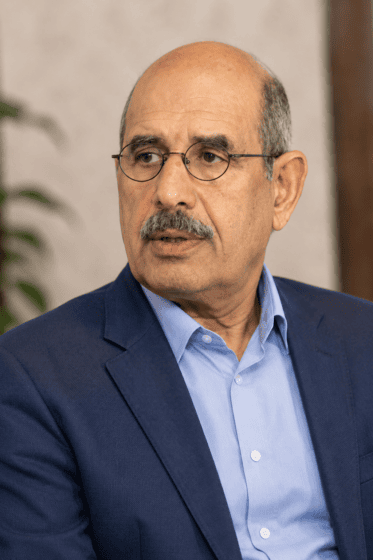
Full Name: Dr. Mohamed ElBaradei
Arabic: محمد مصطفى البرادعي
Born: 17 June 1942
Origin: Egypt
International Honor: Nobel Peace Prize (2005)
Contribution: Served as the Director General of the International Atomic Energy Agency (IAEA), honored for efforts to prevent nuclear energy from being weaponized and ensuring safety in peaceful nuclear technology.
Dr. Mohamed ElBaradei: Nuclear Diplomat and Nobel Peace Laureate
Dr. Mohamed ElBaradei (Arabic: محمد مصطفى البرادعي; born 17 June 1942) is an Egyptian legal scholar and diplomat who became one of the most respected voices in international affairs. As Director General of the International Atomic Energy Agency (IAEA) from 1997 to 2009, he stood at the centre of the world’s most tense nuclear standoffs – over Iraq, Iran, and North Korea – consistently arguing that inspection and diplomacy, not war, offered the surest path to security. In 2005 he and the IAEA were jointly awarded the Nobel Peace Prize. He later returned to Egypt to champion democratic reform and, for a brief period in 2013, served as the country’s interim vice president.
Who Is Mohamed ElBaradei?
Mohamed ElBaradei is, above all, a believer in the power of law and diplomacy to restrain the world’s most dangerous weapons. A lawyer by training and a diplomat by career, he spent decades working to prevent the spread of nuclear arms while promoting the peaceful use of nuclear energy. He earned a global reputation as a calm, independent-minded arbiter who was willing to stand up to great powers when he believed the evidence demanded it. As he often said, “Verification and diplomacy, used together, can work.”
Early Life and Education
ElBaradei was born on 17 June 1942 in Cairo, Egypt, one of five children. His father, Mostafa ElBaradei, was a prominent lawyer who headed the Egyptian Bar Association and was a committed advocate of democratic rights, a free press, and an independent judiciary – values that would deeply shape his son. Following his father’s path into law, ElBaradei earned a bachelor’s degree in law from the University of Cairo in 1962, and went on to complete a doctorate in international law at New York University School of Law in 1974.
A Career in Diplomacy and International Law
ElBaradei began his career in the Egyptian diplomatic service in the 1960s, serving in Egypt’s permanent missions to the United Nations in New York and Geneva, where he worked on political, legal, and arms-control issues. He later served as a special assistant to Egypt’s foreign minister, and in 1980 became a senior fellow in charge of the International Law Programme at the United Nations Institute for Training and Research. In 1984 he joined the IAEA, rising through a series of senior posts – including Legal Adviser and Assistant Director General for External Relations – that prepared him to lead the agency itself.
Leading the IAEA
In 1997, ElBaradei was appointed Director General of the International Atomic Energy Agency, the United Nations body responsible for monitoring nuclear activities worldwide, promoting the safe civilian use of nuclear power, and guarding against the spread of nuclear weapons. He would be re-elected to the post twice, serving three full terms until 2009. Under his leadership, the IAEA oversaw safeguards at hundreds of nuclear facilities across dozens of countries, and ElBaradei worked to strengthen the agency and to broaden support for the global non-proliferation regime.
Iraq, Iran, and the Case for Diplomacy
ElBaradei’s tenure coincided with some of the most fraught nuclear crises of the age. In the lead-up to the 2003 Iraq War, as the United States and its allies argued that Iraq was reconstituting a nuclear weapons programme, the IAEA under ElBaradei found no credible evidence to support that claim. He famously informed the UN Security Council that key documents alleging an Iraqi attempt to acquire uranium were not authentic. His insistence on following the evidence, even under intense pressure from powerful governments, cemented his reputation for independence.
He applied the same patient approach to the long-running disputes over the nuclear programmes of Iran and North Korea, favouring inspection, dialogue, and negotiated solutions over confrontation. It was a stance that sometimes drew criticism from those who wanted a tougher line – but one that earned him wide international respect as a steady, principled mediator.
The 2005 Nobel Peace Prize
In October 2005, Mohamed ElBaradei and the IAEA were jointly awarded the Nobel Peace Prize, cited “for their efforts to prevent nuclear energy from being used for military purposes and to ensure that nuclear energy for peaceful purposes is used in the safest possible way.” The award was widely read as an endorsement of diplomacy and verification over military action as the wiser path to security. The Nobel Committee also praised ElBaradei personally for his courage and for the way he had strengthened the IAEA as an institution.
Return to Egypt and the 2011 Revolution
After stepping down from the IAEA in 2009, ElBaradei returned to Egypt and turned his energies to the cause of democratic reform. In 2010 he founded the National Association for Change, a broad movement – especially popular among young Egyptians – that gathered hundreds of thousands of signatures calling for political change. When mass protests erupted in early 2011 and ultimately forced the resignation of President Hosni Mubarak, ElBaradei emerged as one of the most prominent figures of the pro-democracy opposition and a widely mentioned potential presidential candidate.
The Constitution Party and 2013
In April 2012, ElBaradei launched the Constitution Party (Dostour), a liberal party intended to safeguard the goals of the 2011 revolution, and he became a leading opposition voice. Later that year his party joined others to form the National Salvation Front, a coalition opposing the decrees of President Mohamed Morsi. Amid enormous nationwide protests against Morsi’s rule in mid-2013, the military removed the president from office in July 2013, and ElBaradei supported the transitional roadmap that followed.
Appointed interim vice president for foreign relations and sworn in on 14 July 2013, he held the post for barely a month. On 14 August 2013, after security forces violently dispersed pro-Morsi sit-ins in an operation that left hundreds dead, ElBaradei resigned in protest, saying he could not bear responsibility for decisions he disagreed with. His resignation drew criticism from several sides in Egypt’s polarised politics, and it marked the end of his active role in Egyptian public life; he subsequently based himself largely in Vienna.
Later Life and Legacy
In the years since, ElBaradei has continued to be regarded as an elder statesman of international diplomacy and a voice for tolerance, human rights, and peaceful conflict resolution. He recounted his years at the centre of the world’s nuclear crises in his memoir The Age of Deception: Nuclear Diplomacy in Treacherous Times (2011), and he has remained associated with global initiatives promoting good governance and dialogue.
Mohamed ElBaradei’s legacy rests on a consistent conviction: that even the gravest threats are best met with law, evidence, and negotiation rather than force. As one of the very few figures from the Arab world to reach the highest levels of international affairs, and as a Nobel Peace laureate who spoke uncomfortable truths to the powerful, he remains a significant and principled figure in the modern history of diplomacy.
Frequently Asked Questions
Who is Dr. Mohamed ElBaradei?
He is an Egyptian legal scholar and diplomat, born in 1942, who served as Director General of the International Atomic Energy Agency (IAEA) from 1997 to 2009, won the 2005 Nobel Peace Prize, and briefly served as interim vice president of Egypt in 2013.
Why did Mohamed ElBaradei win the Nobel Peace Prize?
He and the IAEA were jointly awarded the 2005 Nobel Peace Prize for their efforts to prevent nuclear energy from being used for military purposes and to ensure that peaceful nuclear energy is used as safely as possible.
What was ElBaradei’s role before the Iraq War?
As head of the IAEA, he reported that there was no credible evidence that Iraq had revived a nuclear weapons programme, and told the UN Security Council that key documents alleging an Iraqi attempt to obtain uranium were not authentic.
Was Mohamed ElBaradei ever vice president of Egypt?
Yes, briefly. He was appointed interim vice president for foreign relations in July 2013 and resigned about a month later, on 14 August 2013, in protest at the violent dispersal of pro-Morsi protests.
What is ElBaradei doing now?
He has largely retired from front-line politics and lives mainly in Vienna, remaining a respected commentator and advocate for diplomacy, human rights, and democratic reform.
References and Further Reading
Official and Profile Pages
- Mohamed ElBaradei – Facts & Biography — NobelPrize.org
- Mohamed ElBaradei — International Atomic Energy Agency
News and Further Reading
Book
- Mohamed ElBaradei, The Age of Deception: Nuclear Diplomacy in Treacherous Times (Metropolitan Books, 2011) — his memoir of the IAEA years.