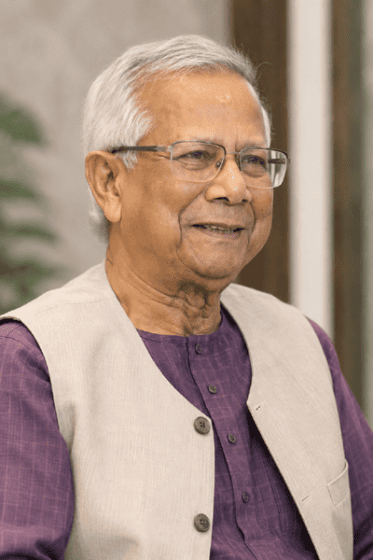
Full Name: Muhammad Yunus
Bengali: মুহাম্মদ ইউনূস
Born: 28 June 1940
Origin: Hathazari, Bengal Province, British India
International Honor: Nobel Peace Prize (2006)
Contribution: Recognized for founding the Grameen Bank and pioneering the concepts of microcredit and microfinance, lifting millions out of poverty globally.
Dr. Muhammad Yunus: Banker to the Poor and Nobel Peace Laureate
Dr. Muhammad Yunus (Bengali: মুহাম্মদ ইউনূস; born 28 June 1940) is a Bangladeshi economist, banker, and statesman celebrated around the world as the pioneer of microcredit and microfinance – the practice of lending small, collateral-free sums to the very poor. As the founder of Grameen Bank, he lifted millions out of poverty and inspired a global movement, work for which he and the bank were jointly awarded the 2006 Nobel Peace Prize, making him the first Bangladeshi Nobel laureate. Decades later, in a remarkable second act, he was called upon to lead his country’s interim government, serving as Chief Adviser of Bangladesh from 2024 to 2026 and overseeing its return to elected rule.
Who Is Muhammad Yunus?
Muhammad Yunus is best known for a single, powerful idea: that the poor are creditworthy, and that access to tiny loans can unlock their own capacity to work their way out of poverty. Often called “the banker to the poor,” he turned that idea into an institution – Grameen Bank – and then into a worldwide model. He is also the champion of “social business,” a form of enterprise designed to solve human problems rather than maximise profit. Across economics, activism, and, most recently, national leadership, his career has been guided by a conviction that poverty is not created by the poor but by the systems around them.
Early Life and Education
Yunus was born on 28 June 1940 in Hathazari, in the Chittagong district of what was then British India, the third of nine children in a Bengali Muslim family; his father was a jeweller and trader. He proved a gifted student, studying at Chittagong Collegiate School and Chittagong College before earning his BA and MA in economics from the University of Dhaka. In 1965 he won a Fulbright scholarship to the United States, where he completed his PhD in economics at Vanderbilt University and then taught as an assistant professor at Middle Tennessee State University. During the 1971 Bangladesh Liberation War, he campaigned from abroad for his country’s independence, and after the birth of Bangladesh he returned home to head the economics department at Chittagong University.
The 1974 Famine and a New Path
The turning point in Yunus’s life came with the devastating famine of 1974. Teaching elegant economic theory while people starved outside his classroom, he felt the gulf between abstract scholarship and human suffering. As he later reflected, he wanted to see whether, simply “as a human being, I could be of some use to some people.” That question would redirect his entire career from the lecture hall to the villages.
The Birth of Microcredit
In 1976, while visiting the poor households of the village of Jobra near his university, Yunus made a discovery that would change the world of development. He met women who wove bamboo furniture but were trapped by moneylenders charging ruinous interest, leaving them almost nothing for their labour. Conventional banks would not lend such tiny amounts to people without collateral. So Yunus lent US$27 of his own money to 42 women – and found that, given a fair chance, they used the loans productively, kept the profits of their own work, and repaid reliably. From that small act grew the modern concept of microcredit.
Grameen Bank: Banking for the Poor
Yunus formalised his experiment, securing loans from established banks to fund his lending to the poor, and on 1 October 1983 the project became a full-fledged independent bank: Grameen Bank (“Village Bank”). Its method was revolutionary in its simplicity. Loans went overwhelmingly to women – more than 94 per cent – who were more likely to invest in their families, and borrowers were organised into small “solidarity groups” whose members supported and encouraged one another’s repayment. The results were striking: by 2007 Grameen had lent billions of dollars to millions of borrowers, with high repayment rates that defied conventional banking wisdom. The Grameen microfinance model went on to inspire similar programmes in around 100 countries, in the developing and developed world alike.
Social Business and the Grameen Family
Grameen grew into a family of ventures addressing many facets of poverty, including Grameen Telecom (with a stake in Grameenphone, which brought mobile connectivity to tens of thousands of villages), agriculture and fisheries foundations, and Grameen Danone, a joint venture to produce affordable, nutrient-rich food for children. Out of these efforts Yunus articulated his concept of “social business” – companies created to solve social problems and reinvest their profits rather than enrich shareholders. He founded the Yunus Centre in Dhaka in 2008 as a hub for these ideas, and set out a bold vision, captured in his book A World of Three Zeros, of a future with zero poverty, zero unemployment, and zero net carbon emissions.
The 2006 Nobel Peace Prize
In 2006, Muhammad Yunus and Grameen Bank were jointly awarded the Nobel Peace Prize “for their efforts to create economic and social development from below.” The Nobel Committee recognised that lasting peace cannot be achieved unless large populations find ways to break out of poverty, and that microcredit had become a powerful instrument in that struggle. Yunus became the first Bangladeshi to win a Nobel Prize, and a source of enormous national pride. Characteristically, he announced that he would direct much of his share of the prize toward social ventures for the poor.
Honours and Global Influence
Yunus is one of only a handful of people in history to have received the Nobel Peace Prize, the United States Presidential Medal of Freedom (2009), and the Congressional Gold Medal (2010). His many other honours include the Ramon Magsaysay Award, the World Food Prize, and more than seventy honorary doctorates from universities across dozens of countries. He served as a founding member of The Elders, the group of global statespeople convened by Nelson Mandela, sat on numerous United Nations and international commissions, and advised on social-business initiatives for events including the Paris 2024 Olympics.
Years of Conflict at Home
Yunus’s international acclaim was not always matched by ease at home. His relationship with the government of Prime Minister Sheikh Hasina grew strained, particularly after he briefly explored forming a political party in 2007. In 2011 he was removed as managing director of Grameen Bank, and in the years that followed he faced a large number of legal cases – including labour-law and corruption allegations – which he and many international observers described as politically motivated. In January 2024 he was convicted in a labour-law case, a verdict that human-rights organisations sharply criticised; following the change of government later that year, the conviction was overturned and he was acquitted in the other cases.
Leading Bangladesh’s Interim Government
In the summer of 2024, a student-led movement known as the July Uprising forced Prime Minister Sheikh Hasina to resign and leave the country. With the state in crisis, the student leaders called for Yunus to lead a transitional administration, and on 8 August 2024 he was sworn in as the Chief Adviser of Bangladesh, the head of an interim government. His administration set out to stabilise the country and to prepare sweeping reforms, appointing commissions to revise the constitution and build political consensus, an effort that produced a reform blueprint known as the July Charter.
True to the interim government’s core pledge, Yunus oversaw a general election held on 12 February 2026, alongside a national referendum on the reform charter. After the Bangladesh Nationalist Party won a decisive victory, Yunus delivered a farewell address to the nation and his government stepped down on 16 February 2026, handing power to the newly elected government. Having repeatedly said he had no wish to remain in office, he returned to private life, his central promise – a peaceful, democratic transition – fulfilled.
Legacy
Muhammad Yunus’s place in history rests, above all, on an idea that dignified the poor: that they are not a burden to be managed but entrepreneurs to be trusted. Through Grameen Bank and the global microfinance movement it inspired, he changed how the world thinks about poverty, banking, and human potential. That he was later entrusted with steering his own nation through a moment of profound crisis – and chose to hand power back to its people – only deepened his standing as one of the most consequential figures Bangladesh, and the wider Muslim world, has produced. His life stands as testimony to a simple, radical faith in the capacity of ordinary people to build a better future.
Frequently Asked Questions
Who is Dr. Muhammad Yunus?
He is a Bangladeshi economist and statesman, born in 1940, who pioneered microcredit, founded Grameen Bank, won the 2006 Nobel Peace Prize, and later served as head of Bangladesh’s interim government from 2024 to 2026.
What did Muhammad Yunus win the Nobel Peace Prize for?
He and Grameen Bank were jointly awarded the 2006 Nobel Peace Prize for their efforts to create economic and social development from below, chiefly through microcredit – small loans to the poor, especially women.
What is microcredit?
Microcredit is the practice of lending very small, collateral-free amounts to poor people so they can start or grow tiny businesses. Yunus pioneered it in 1976 by lending US$27 to 42 women in the village of Jobra.
What role did Yunus play in Bangladesh’s government?
Following the 2024 July Uprising and the fall of Sheikh Hasina’s government, he became Chief Adviser (head of the interim government) in August 2024, oversaw reforms and a general election, and stepped down in February 2026 when an elected government took office.
What other honours has Muhammad Yunus received?
He is one of very few people to hold the Nobel Peace Prize, the US Presidential Medal of Freedom, and the Congressional Gold Medal, along with the Ramon Magsaysay Award, the World Food Prize, and many honorary degrees.
References and Further Reading
Official and Profile Pages
News and Further Reading
- “Profile: Muhammad Yunus, ‘world’s banker to the poor,’” BBC News: bbc.co.uk.
- “Bangladesh’s interim leader Yunus steps down as new gov’t set to take over,” Al Jazeera (Feb 2026): aljazeera.com.
Books
- Muhammad Yunus, Banker to the Poor: Micro-Lending and the Battle Against World Poverty (PublicAffairs, 1999).
- Muhammad Yunus, A World of Three Zeros: The New Economics of Zero Poverty, Zero Unemployment, and Zero Carbon Emissions (PublicAffairs, 2017).