
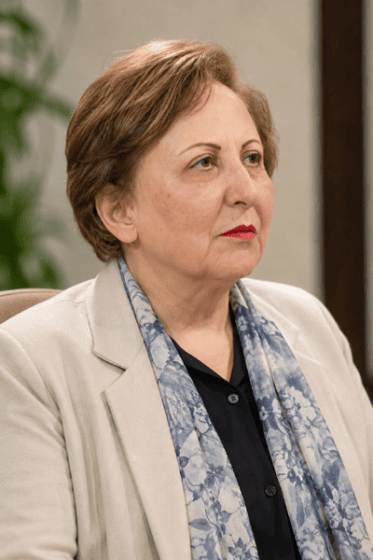
Full Name: Shirin Ebadi
Persian: شيرين عبادى
Born: 21 June 1947
Origin: Hamadan, western Iran
International Honor: Nobel Peace Prize (2003)
Contribution: Internationally recognized lawyer and human rights activist, noted for her significant struggle for the rights of women, children, and political dissidents.
Dr. Shirin Ebadi: Iran’s First Female Judge and Nobel Peace Laureate
Dr. Shirin Ebadi (Persian: شيرين عبادى; born 21 June 1947) is an Iranian lawyer, former judge, writer, and human rights activist who became, in 2003, the first Muslim woman and the first Iranian to win the Nobel Peace Prize. Honoured for her pioneering efforts on behalf of democracy and the rights of women, children, and refugees, she has spent her life using the law as a tool for justice. Once one of Iran’s first female judges, and today a defender of the persecuted who works from exile, Ebadi remains one of the most courageous and internationally respected voices for human rights in the Muslim world.
Who Is Shirin Ebadi?
Shirin Ebadi is a jurist who transformed her legal training into a lifelong instrument of resistance. As a lawyer she took on the cases that few others would touch – defending dissidents, journalists, abused children, and members of persecuted minorities – and as an advocate she built institutions to protect the vulnerable. Central to her thought is the conviction that human rights and Islam are not in conflict. As she has often said, she is “against patriarchy, not Islam,” arguing that an interpretation of the faith in harmony with equality and democracy is an authentic expression of belief.
Early Life and Education
Ebadi was born on 21 June 1947 in the city of Hamadan, in western Iran, into an educated and loving family; her father was the city’s chief notary public and a teacher of commercial law. When she was an infant the family moved to Tehran. She and her siblings were raised as equals – an upbringing she later credited for her strong sense of justice. She studied law at the University of Tehran, earning her degree in 1969, and went on to complete a doctorate in law in 1971.
Iran’s First Female Judge
Ebadi’s early career was groundbreaking. After passing the qualifying examinations, she became a judge in 1969 – one of the first women ever to serve on the bench in Iran – and in 1975 she rose to become president of the Tehran city court, believed to be the first Iranian woman to hold such a position.
Her judicial career, however, was cut short by the 1979 Iranian Revolution. Under the new order, women were deemed ineligible to serve as judges, and Ebadi and her female colleagues were dismissed – she was reassigned to a clerical role in the very court she had once led. Denied the ability to practise law for years afterward, she turned to writing books and articles, and did not obtain a licence to work as a lawyer until the early 1990s.
A Lawyer for the Voiceless
Once able to practise, Ebadi devoted herself to pro bono cases that others feared to take. She represented the families of intellectuals and dissidents killed in a wave of assassinations in the late 1990s, and the family of a student killed during the 1999 Tehran university protests. She became known for defending journalists, banned writers, and the families of victims of state violence, and she was repeatedly harassed, and at one point briefly imprisoned, for her work.
Her advocacy for the vulnerable was especially powerful in the field of women’s and children’s rights. She used harrowing individual cases to expose the injustices of Iran’s custody and family laws, helped draft legislation against the physical abuse of children that was passed by parliament in 2002, and founded non-governmental organisations to protect children and defend human rights – including the Defenders of Human Rights Center, which she co-founded in 2001.
The 2003 Nobel Peace Prize
On 10 October 2003, the Norwegian Nobel Committee awarded Shirin Ebadi the Nobel Peace Prize “for her efforts for democracy and human rights,” with particular recognition of her work for the rights of women and children. She became the first Muslim woman and the first Iranian ever to receive the honour. The Committee praised her as a courageous person who had never heeded the threats to her own safety, and expressed the hope that the award would support Iran’s reform movement and reduce tensions between the Islamic and Western worlds.
In her acceptance speech, Ebadi argued that Islam is compatible with democracy, human rights, and freedom of opinion, while also criticising repression at home and aspects of Western foreign policy – a characteristically independent stance. Thousands of supporters greeted her at the airport on her return, though officials in Iran gave the award a cool, and at times critical, reception.
Exile and Continued Advocacy
In June 2009, Ebadi was abroad when mass protests erupted over Iran’s disputed presidential election and the authorities launched a sweeping crackdown. Warned by colleagues not to return, she has lived in exile in London since 2009. In the years that followed she faced intense pressure – her family members were harassed and detained, her human rights centre was raided and shut, and Iranian authorities seized assets belonging to her, reportedly including her Nobel medal, an action Iran denied.
From exile, Ebadi has continued her work without pause. She has lectured at universities around the world, defended prisoners of conscience, and spoken out on behalf of persecuted minorities and political detainees. With five fellow female laureates she co-founded the Nobel Women’s Initiative to advance peace, justice, and women’s rights, and she has remained an outspoken commentator on human rights in Iran, continuing to condemn the use of violence against protesters into recent years.
Writings and Ideas
Ebadi is also an accomplished author who has used her books to reach a global audience. Her memoir Iran Awakening (2006) recounts her journey from judge to dissident lawyer, and later works such as The Golden Cage (2011) and Until We Are Free (2016) chronicle Iran’s political struggles and her own fight from exile. Across her writing runs a consistent message: that lasting change in Iran must come peacefully and from within, and that faith, properly understood, supports rather than denies human dignity.
Legacy and Significance
Shirin Ebadi’s legacy is that of a fearless advocate who showed that one determined individual, armed with the law and moral conviction, can challenge injustice even at great personal cost. As the first Muslim woman to win the Nobel Peace Prize, she became a global symbol of the compatibility of Islam with democracy and women’s rights, and an inspiration to reformers and human rights defenders far beyond Iran. Stripped of her judgeship, exiled from her homeland, and targeted for her beliefs, she has never fallen silent – a living testament to the power of principled, peaceful resistance.
Frequently Asked Questions
Who is Dr. Shirin Ebadi?
She is an Iranian lawyer, former judge, and human rights activist, born in 1947, who in 2003 became the first Muslim woman and first Iranian to win the Nobel Peace Prize.
Why did Shirin Ebadi win the Nobel Peace Prize?
She was awarded the 2003 Nobel Peace Prize for her pioneering efforts for democracy and human rights, especially the rights of women, children, and refugees in Iran.
Was Shirin Ebadi really Iran’s first female judge?
She was one of the first women to serve as a judge in Iran and became president of the Tehran city court in 1975. After the 1979 revolution, women were barred from serving as judges and she was removed from the bench.
Why does Shirin Ebadi live in exile?
She has lived in London since 2009, having been abroad when a crackdown followed Iran’s disputed presidential election that year; colleagues advised her not to return, and she has continued her human rights work from exile.
What are Shirin Ebadi’s best-known books?
Her memoir Iran Awakening (2006) is the most famous, followed by The Golden Cage (2011) and Until We Are Free (2016).
References and Further Reading
Official and Profile Pages
News and Further Reading
Books by Shirin Ebadi
- Iran Awakening: One Woman’s Journey to Reclaim Her Life and Country (2006).
- The Golden Cage: Three Brothers, Three Choices, One Destiny (2011).
- Until We Are Free: My Fight for Human Rights in Iran (2016).


