
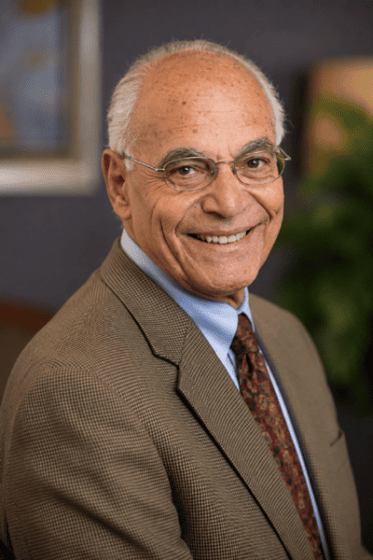
Full Name: Dr. Farouk El-Baz
Arabic: فاروق الباز
Born: 2 January 1938
Origin: Zagazig, Egypt
International Honor: NASA Achievement Awards, NASA Apollo Achievement Awards, and numerous geological society medals.
Contribution: Played a vital role in NASA’s Apollo program, selecting landing sites on the Moon and training astronauts in lunar geology, later pioneering the use of space photography to study desert arid lands on Earth.
Dr. Farouk El-Baz: The Egyptian Scientist Who Helped Choose the Moon Landing Sites
Dr. Farouk El-Baz (Arabic: فاروق الباز; born 2 January 1938) is an Egyptian-American space scientist and geologist who played a pivotal role in one of humanity’s greatest adventures: the Apollo Moon landings. As a young geologist, he helped NASA select the landing sites for the Apollo missions and trained the astronauts to observe and photograph the Moon — work so valued that the astronauts nicknamed him “the King.” In the decades since, he has become a world authority on the use of satellite imagery to study deserts and, remarkably, to find groundwater beneath some of the driest places on Earth. His career links the exploration of the Moon with the sustaining of life on our own planet.
Who Is Farouk El-Baz?
Farouk El-Baz is a scientist whose vision has reached from lunar orbit to the sands of the Sahara. He is best known for two great bodies of work: his contributions to the Apollo program in the 1960s and 1970s, and his pioneering use of remote sensing — the analysis of images taken from space — to understand Earth’s deserts and locate the hidden water within them. Along the way he has served as a museum builder, a professor, a science adviser, and an ambassador for science across the Arab world.
Early Life and Education
El-Baz was born on 2 January 1938 in the Nile Delta town of Zagazig, Egypt. He earned a bachelor’s degree in chemistry and geology from Ain Shams University in Cairo in 1958, and then travelled abroad for advanced study, receiving a master’s degree in geology from the Missouri School of Mines and Metallurgy and a doctorate in geology from the University of Missouri, with research conducted at the Massachusetts Institute of Technology (MIT). He also taught geology in Germany before his career took a dramatic turn toward the Moon.
The Apollo Program: Charting a Path to the Moon
From 1967 to 1972, El-Baz worked at the heart of the Apollo program as Supervisor of Lunar Science Planning at Bellcomm Inc., a division of AT&T that carried out systems analysis for NASA. In this role he took on three crucial responsibilities: he was Secretary of the Landing Site Selection Committee for the Apollo Moon missions, Principal Investigator of Visual Observations and Photography, and Chairman of the Astronaut Training Group.
Poring over thousands of images returned by the Lunar Orbiter probes, El-Baz helped identify and evaluate the terrain that would make safe, scientifically valuable landing sites — work that fed directly into the historic touchdown of Apollo 11 in 1969 and the missions that followed. When Apollo 11’s lunar module descended to the surface, El-Baz was in Mission Control as secretary of the site-selection committee, watching a plan he had helped shape become reality.
Training the Astronauts — and a Touch of the Divine
Perhaps El-Baz’s most personal contribution was as a teacher. He trained the Apollo astronauts to read the lunar landscape with a geologist’s eye and to capture the most scientifically important features on film. His teaching was so effective that the astronauts affectionately dubbed him “the King.” Orbiting the Moon during Apollo 15, Command Module Pilot Alfred Worden paid him a famous tribute: “After the King’s training, I feel like I’ve been here before.” El-Baz’s renown even reached popular culture, when a shuttlecraft in Star Trek: The Next Generation was named “El-Baz” in his honour.
In a striking blend of science and heritage, El-Baz is also credited with the idea of placing a touchable Moon rock on public display in a museum — an inspiration he traced to his childhood pilgrimage to Mecca, where he had touched the Black Stone. The touchable lunar sample he championed has since let millions of ordinary visitors make their own physical connection to the Moon.
From the Moon to the Smithsonian
After the Apollo program concluded in 1972, El-Baz joined the Smithsonian Institution in Washington, D.C., where he founded and directed the Center for Earth and Planetary Studies at the National Air and Space Museum. He served as a member of the International Astronomical Union’s Lunar Nomenclature Task Group, helping to name features on the Moon, and he took part in the Earth Observations and Photography experiment aboard the 1975 Apollo-Soyuz Test Project, the first joint US-Soviet space mission.
Finding Water in the Desert
In 1986, El-Baz joined Boston University, where he founded and long directed the Center for Remote Sensing, promoting the use of space technology in geology, geography, and archaeology. It was here that he developed the work for which he is perhaps most admired today. Turning the same skills he had used to read the surface of the Moon toward the deserts of Earth, El-Baz became a world leader in using satellite imagery to understand how deserts form — and, crucially, to locate underground water in arid regions from Egypt’s Western Desert to Darfur. His methods have offered hope of new water sources to some of the world’s most parched and vulnerable communities, and he has applied remote sensing to uncover buried archaeological sites as well.
Serving Egypt and Science
El-Baz has remained deeply committed to his homeland and to science in the Arab world. He served as a science adviser to Egyptian President Anwar Sadat from 1978 to 1981, and has long promoted large-scale development ideas for Egypt, including a proposed national “development corridor” to expand habitation and agriculture beyond the crowded Nile Valley. As an adjunct professor at Ain Shams University and a frequent public voice, he has worked to inspire young Arab scientists and to demonstrate the practical value of space technology for development. (His brother, Osama El-Baz, was a prominent Egyptian presidential adviser.)
Honours and Recognition
El-Baz’s achievements have been recognised around the world. His honours include NASA’s Apollo Achievement Award and Exceptional Scientific Achievement Medal, the Arab Republic of Egypt’s Order of Merit (First Class), and election to the United States National Academy of Engineering. An asteroid, 7371 Farouk El-Baz, has been named in his honour — a fitting tribute for a man who helped humanity reach another world.
Legacy and Significance
Farouk El-Baz’s career is a bridge between the heavens and the Earth. He helped guide humanity’s first steps on another world, and then turned the tools of space exploration back toward our own planet to help solve one of its most fundamental problems — the need for water. As one of the most celebrated Arab and Muslim scientists of the modern era, he has shown how curiosity, rigorous science, and service can combine to benefit all humankind. From the plains of the Moon to the sands of the Sahara, the work of “the King” continues to inspire.
Frequently Asked Questions
Who is Dr. Farouk El-Baz?
He is an Egyptian-American space scientist and geologist, born in 1938, who helped NASA select the Apollo Moon landing sites and train astronauts, and later pioneered the use of satellite imagery to find groundwater in deserts.
What did Farouk El-Baz do for the Apollo program?
From 1967 to 1972 he was Secretary of the Landing Site Selection Committee, led visual observation and photography planning, and chaired the astronaut training group, helping choose where the Apollo missions would land and teaching astronauts to study the Moon.
Why did astronauts call him “the King”?
It was a nickname of respect for his outstanding training. Apollo 15’s Alfred Worden said that after El-Baz’s training he felt he had “been here before” when he first saw the Moon up close.
What is Farouk El-Baz’s desert research?
At Boston University he used remote sensing (satellite imagery) to study how deserts form and to locate underground water in arid regions such as Egypt’s Western Desert and Darfur, offering new water sources to dry communities.
Has anything been named after Farouk El-Baz?
Yes. An asteroid, 7371 Farouk El-Baz, is named in his honour, and a shuttlecraft in Star Trek: The Next Generation was named “El-Baz” after him.
References and Further Reading
Official and Profile Pages
Further Reading
- Dr. Farouk El-Baz — Arab America
- Farouk El-Baz: The Egyptian Scientist Who Worked with NASA’s Apollo Program — Embassy of Egypt, Washington DC
Book
- Farouk El-Baz (co-editor), Apollo Over the Moon: A View from Orbit (NASA SP-362, 1978) — a landmark study of the Moon from Apollo photography.