Who Is Hasan al-Basri?
Hasan al-Basri is a scholar whose vision bridged the early days of Islam with the formalization of its sciences. He is best known for two great bodies of work: his foundational contributions to Islamic jurisprudence and Quranic exegesis in the 7th and 8th centuries, and his profound sermons on morality, death, and the hereafter—which earned him the title “The Master of the Ascetics.” Along the way, he served as a teacher, a voluntary judge (Qadi), and a fearless spiritual guide for the people of Iraq.
Early Life and Education
Al-Hasan was born in 642 CE in Medina. His parents were freed slaves; his father was a prisoner of war from Maysan, and his mother, Khayyirah, was a maid to the Prophet’s wife, Umm Salamah. This proximity to the Prophet’s household allowed the young al-Hasan to be raised among the Prophet’s companions. He memorized the Quran as a youth and later moved to Basra (in modern-day Iraq), where he would spend the majority of his life. He studied under prominent companions, including Uthman ibn Affan and Ali ibn Abi Talib, before establishing himself as a leading scholar in the mosque of Basra.
Public Life and Speaking Truth to Power
From his base in Basra, al-Hasan emerged as a central figure in the community. He was widely respected for his vast knowledge of Hadith, jurisprudence, and Arabic rhetoric. In 102 AH, he was appointed as the judge of Basra, though he performed the role voluntarily and without pay.
Beyond the classroom, al-Hasan was famous for his fearless public sermons. He is particularly noted for his opposition to the Umayyad governor al-Hajjaj ibn Yusuf, whose harsh policies he criticized openly from the pulpit. His courage in the face of political tyranny made him a symbol of religious integrity and moral resistance.
Defending Free Will and Divine Justice
Perhaps al-Hasan’s most personal contribution was in the field of theology. He was a staunch defender of human free will (Qadar) and moral responsibility. In a famous epistle to the Umayyad Caliph Abd al-Malik, he argued that God does not compel humans to sin, and that evil acts cannot be attributed to divine decree. He maintained that God’s omniscience does not negate human agency; rather, God knows what humans will freely choose to do. His teachings were so effective in shaping early Islamic thought that they influenced the later Mu‘tazilite school, though his position was nuanced, seeking a middle ground between absolute determinism and total human independence.
A Touch of the Divine: Asceticism and the Roots of Mysticism
In a striking blend of scholarship and spiritual heritage, al-Hasan is credited with being a foundational figure for Islamic mysticism (Sufism). His teachings emphasized reflection (muraqaba), scrupulousness (wara‘), and the constant remembrance of death and the hereafter. He was known to weep profusely when reciting the Quran and lived a life of profound detachment from worldly pleasures. Later Sufi traditions, particularly from the Basran school, would trace their spiritual lineages back to him, viewing him as a forefather of the “science of hearts.”
From Basra to the Mythical
After his death, al-Hasan’s legacy became a battleground for various theological movements. While he was undoubtedly a man of immense piety and learning, modern scholarship indicates that many sayings, letters, and stories attributed to him were actually forged centuries later by groups eager to legitimize their own doctrines by associating them with his name. The “mythical” al-Hasan—the ultimate ascetic and founding father of multiple movements—was largely a product of later medieval scholarship. However, the historical al-Hasan remains a giant of early Islam, and his tomb in Basra remains a site of visitation for millions.


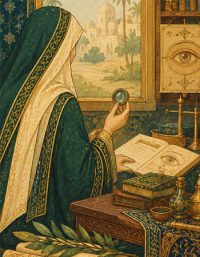 7th c.
Profile
Zaynab al-Awadiya
زينب الأوَدية
One of the earliest named women eye-doctors in Arab history
 653–729
Profile
Ibn Sirin
ابن سيرين
Hadith scholar of Basra, famous for the interpretation of dreams
 7th–8th c.
Profile
Abd al-Malik ibn Abjar al-Kinani
عبد الملك بن أبجر الكناني
Physician of Alexandria and of Caliph Umar ibn Abd al-Aziz
 d. c.758
Profile
Maryam Al-Zinyani
مريم الزينياني
Early woman poet and alchemist


