
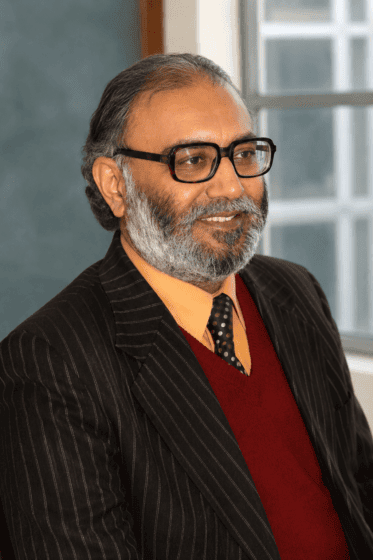
Full Name: Dr. Abdus Salam
Arabic: ڈاکٹر عبدالسلام
Born: 29 January 1926
Died: 21 November 1996
Origin: Jhang, Punjab Province, British India (present day Punjab, Pakistan
International Honor: Nobel Prize in Physics (1979)
Contribution: Awarded for his contributions to the theory of the unified weak and electromagnetic interaction between elementary particles, including the prediction of the weak neutral current (the Electroweak Theory, alongside the Pati-Salam model). He was the first Muslim scientist to win a Nobel Prize.
Dr. Abdus Salam: Pakistan’s Nobel Laureate and Father of the Electroweak Theory
Dr. Abdus Salam (29 January 1926 – 21 November 1996) was a Pakistani theoretical physicist and one of the towering scientific minds of the twentieth century. In 1979 he shared the Nobel Prize in Physics for the electroweak theory, which unified two of the fundamental forces of nature – becoming the first Pakistani and the first Muslim scientist to win a Nobel Prize. Beyond his own discoveries, Salam was the architect of modern science in Pakistan, the founder of a world-famous research centre for scientists from the developing world, and a lifelong champion of the idea that great science belongs to all of humanity.
Who Was Abdus Salam?
Abdus Salam was a rare combination of brilliant theorist, institution-builder, and humanitarian. His scientific work lies at the very foundation of the Standard Model of particle physics – the framework that describes the basic building blocks of the universe. As a public figure, he devoted enormous energy to raising up science in the Global South, and to nurturing generations of physicists from Pakistan and beyond. His life was also marked by a painful paradox: a man who brought his country its greatest scientific honour, yet who left it in protest and remained, for decades, under-recognised at home.
Early Life and Education
Salam was born on 29 January 1926 in Jhang, in the Punjab of British India (now Pakistan), into a family of modest means with a strong tradition of learning; his father was a schoolteacher. A child prodigy, he set records almost from the start: at fourteen he scored the highest marks ever recorded in the Punjab University entrance examination, and as a student he published an elegant solution to a mathematical problem associated with the great Indian mathematician Srinivasa Ramanujan.
After taking his master’s degree at Government College, Lahore, Salam won a scholarship to St John’s College, Cambridge, where he earned a Double First in mathematics and physics and the Smith’s Prize for the most outstanding pre-doctoral contribution to physics. For his doctorate at the Cavendish Laboratory, he solved a stubborn problem in quantum field theory – the renormalisation of meson theory – that had defied leading physicists, and his 1951 thesis earned him an international reputation before he had even turned thirty.
A Career at the Frontier of Physics
Salam briefly returned to Pakistan to teach, but found little support for advanced research and, unable to build a school of physics at home, went back to Britain. In 1957 he joined Imperial College London, where he helped create one of the world’s foremost centres of theoretical physics. In 1959, at the age of thirty-three, he became one of the youngest scientists ever elected a Fellow of the Royal Society. Around him gathered a remarkable community of physicists – many of them his own Pakistani students – and his lectures were legendary, delivered with an eloquence that could make particle physics feel like poetry.
The Electroweak Theory and the Nobel Prize
Salam’s greatest achievement was the electroweak theory. Physicists recognised four fundamental forces in nature; Salam, working in the same years as Sheldon Glashow and Steven Weinberg, showed that two of them – the electromagnetic force and the weak nuclear force – are in fact two aspects of a single, deeper “electroweak” force, a name Salam himself gave it. The theory predicted the existence of the weak neutral current and of the W and Z particles, later confirmed by experiment, and it became a cornerstone of the Standard Model.
For this work, Salam, Glashow, and Weinberg were awarded the 1979 Nobel Prize in Physics. In a gesture that captured his character, Salam later travelled to India to place his Nobel medal in the hands of his old mathematics teacher, Anilendra Ganguly, telling him the prize was the fruit of the love of mathematics his teacher had instilled in him.
Building Science in Pakistan
Even while pursuing frontier research abroad, Salam poured himself into building his homeland’s scientific capacity. As Science Advisor to the President of Pakistan from 1960 to 1974, he helped lay the foundations of the country’s modern scientific infrastructure. He was the founding director of the Space and Upper Atmosphere Research Commission (SUPARCO), Pakistan’s national space agency; he was instrumental in establishing the Pakistan Institute of Nuclear Science and Technology (PINSTECH) and the Theoretical Physics Group; and he launched the International Nathiagali Summer College to bring the world’s scientists to Pakistan each year.
He is widely remembered as the “father of Pakistani theoretical physics.” By one estimate, Salam was responsible for sending some five hundred Pakistani scientists and mathematicians abroad for doctoral study at leading institutions – an investment in human talent whose effects are still felt today.
The ICTP: Science for the Developing World
Perhaps Salam’s most enduring institutional legacy is the International Centre for Theoretical Physics (ICTP), which he founded in Trieste, Italy, in 1964 and directed for nearly three decades. The ICTP was built on a simple but radical conviction: that talented scientists from poor countries should not have to emigrate permanently to do great work. It gave them a place to collaborate with leading researchers and remain connected to the global scientific community, and it has trained scientists from the developing world ever since. Salam also founded the Third World Academy of Sciences (TWAS) to the same end.
He believed that “scientific thought is the common heritage of mankind,” and he lived that creed: he spent the money from his Atoms for Peace Prize and his share of the Nobel Prize almost entirely on funds and fellowships for physicists from developing nations, keeping little for himself. In 1997, the year after his death, the ICTP was renamed the Abdus Salam International Centre for Theoretical Physics in his honour.
Faith and Science
Salam was a deeply religious man who saw no conflict between his faith and his science – indeed, he regarded them as inseparable. His very name, Abd al-Salam (“servant of God,” Salam being one of the names of God in the Qur’an), reflected that devotion. In his Nobel Prize banquet speech he quoted verses of the Qur’an inviting humankind to contemplate the order and harmony of creation, and he spoke of the physicist’s sense of wonder as a form of that same reflection. For Salam, the pursuit of the deep laws of nature was itself an act of faith.
Exile and a Complicated Homeland
Salam belonged to the Ahmadiyya Muslim community. In 1974, the Parliament of Pakistan passed a constitutional amendment that declared members of the Ahmadiyya community to be non-Muslim under Pakistani law. In protest, Salam left Pakistan and settled in London, though he never severed his emotional and scientific ties to his homeland, continuing to mentor its scientists for the rest of his life.
The consequences of this designation followed him even in death. Salam died in 1996 and was buried in Pakistan; tens of thousands attended his funeral. The epitaph on his tomb originally described him as the “First Muslim Nobel Laureate,” but under the legal definitions then in force, authorities had the word “Muslim” removed from the headstone. For many years his name went largely unmentioned in Pakistani textbooks, and his towering scientific achievements were overshadowed by controversy over his faith – a source of sorrow to his admirers and colleagues, who felt their country had not given one of its greatest sons his due.
Recognition and Legacy
Over time, recognition of Salam’s greatness has grown, both abroad and at home. Internationally, his memory is honoured at the institutions he graced: there is a “Route Salam” at CERN in Geneva, an English Heritage blue plaque at his longtime London home, and in 2023 Imperial College London named its central library the Abdus Salam Library. In Pakistan, a measure of rehabilitation came in 2016, when the government approved the renaming of the physics centre at Quaid-i-Azam University as the Professor Abdus Salam Centre for Physics, along with a fellowship in his name. His life and science reached new audiences through the acclaimed documentary released on Netflix in 2019.
Above all, his scientific legacy endures. The electroweak theory remains central to physics, and the 2012 discovery of the Higgs boson at CERN was, in part, a vindication of the theoretical edifice Salam helped build. Through the thousands of scientists trained at the ICTP, the students he mentored, and the institutions he founded, Dr. Abdus Salam continues to shape science across the world – a physicist of the first rank who never stopped believing that knowledge is the shared inheritance of all humanity.
Frequently Asked Questions
Who was Dr. Abdus Salam?
He was a Pakistani theoretical physicist (1926-1996) who shared the 1979 Nobel Prize in Physics for the electroweak theory, becoming the first Pakistani and first Muslim scientist to win a Nobel Prize.
What did Abdus Salam discover?
He was a principal architect of the electroweak theory, which unified the electromagnetic and weak nuclear forces – a cornerstone of the Standard Model of particle physics – and predicted phenomena later confirmed experimentally, such as the weak neutral current.
What did Salam do for science in Pakistan and the developing world?
He founded Pakistan’s space agency SUPARCO, helped build its nuclear science institutions, and is called the father of Pakistani theoretical physics. He also founded the ICTP in Trieste and the Third World Academy of Sciences to support scientists from developing countries.
Why did Abdus Salam leave Pakistan?
He left in protest in 1974 after Parliament passed a constitutional amendment declaring the Ahmadiyya community, to which he belonged, non-Muslim under Pakistani law. He continued to support Pakistani science from abroad throughout his life.
How is Abdus Salam remembered today?
The ICTP he founded now bears his name, as do libraries and institutions in the UK and Pakistan, and his 2016 recognition at Quaid-i-Azam University marked a measure of rehabilitation at home. His electroweak theory remains fundamental to physics.
References and Further Reading
Official and Profile Pages
- Abdus Salam – Biographical — NobelPrize.org
- Our History — Abdus Salam International Centre for Theoretical Physics (ICTP)
- Professor Abdus Salam — Imperial College London
News and Further Reading
- Hasham Cheema, “Abdus Salam: The real story of Pakistan’s Nobel prize winner,” Dawn: dawn.com.
- M. Ilyas Khan, “Why has this Nobel winner been ignored for 30 years?” BBC News: bbc.com.
Books
- Gordon Fraser, Cosmic Anger: Abdus Salam — The First Muslim Nobel Scientist (Oxford University Press, 2008) — the standard biography.
- Jagjit Singh, Abdus Salam: A Biography (Penguin Books, 1992).


